

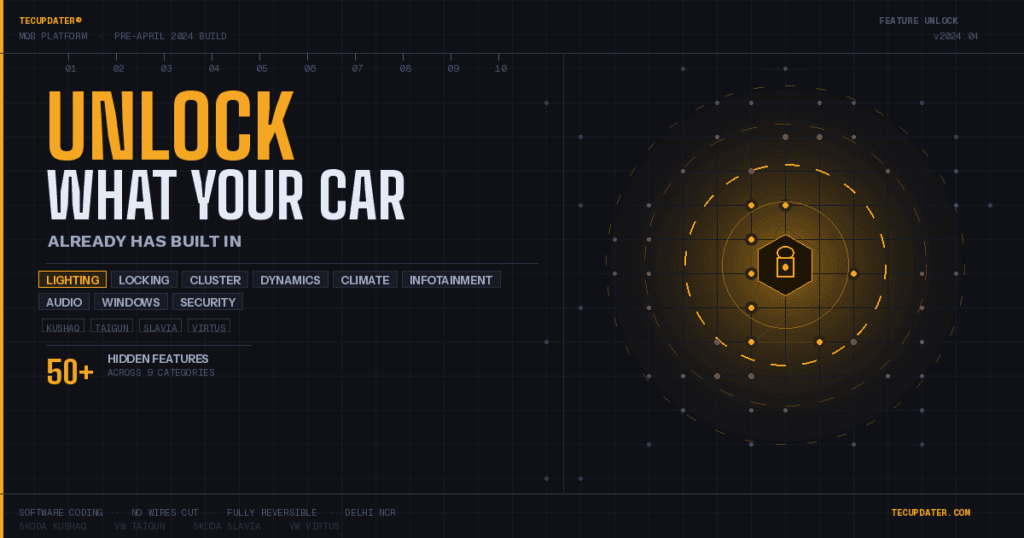
Unlock 50+ factory-disabled features on your Skoda Kushaq, VW Taigun, Skoda Slavia, VW Virtus or Skoda Kylaq through safe OBD-II ECU coding — no wires cut, no hardware modification, fully reversible. Features span lighting, driving dynamics, infotainment, instrument cluster, climate control, locking and more. Available for cars built before and after April 2024. Serving Delhi NCR; remote guidance available for outstation customers.
Hidden Feature Unlocks
for VW & Skoda MQB Cars
Your Kushaq, Taigun, Virtus, Slavia, or Kylaq shipped with dozens of features disabled from the factory. These are software-only unlocks via OBD-II — no cutting, no soldering, fully reversible.
Cars Built Before April 2024
Kushaq · Taigun · Slavia · Virtus | These cars have the widest unlock list due to a more open ECU coding structure on earlier production runs.
By default, MQB cars in India use only the front DRLs when the light switch is in Auto mode. This unlock activates the rear light cluster as an additional DRL, giving the car a more distinctive road presence and improving visibility to following drivers during the day.
Restricts DRL operation to Auto mode only — the OEM-intended behaviour for European-spec cars. When the driver manually selects a lighting mode, the DRLs behave as designed for that mode.
DRLs automatically switch off when the handbrake is engaged. Useful for preventing DRL glare while parked in tight spots or waiting in traffic.
Exposes DRL on/off and behaviour settings inside the MIB2 8-inch infotainment system’s car settings menu — allowing the driver to adjust DRL behaviour without requiring a diagnostic tool.
When an indicator is activated, the DRL on that side dims or switches off so the amber turn signal stands out clearly. Standard on premium European cars — significantly improves indicator visibility in bright daylight.
The rear light cluster has three distinct segments — the brake lamp portion, the body-side tail strip, and the boot-lid tail strip. This unlock allows any one of these segments to blink in sync with the indicator on that side, creating a dynamic rear signal effect.
Makes the ORVM indicator blink alternately (out of phase) with the main turn signal — creating a cascading ping-pong effect between mirror and front/rear indicators. A subtle but premium-looking detail.
Activates the front fog light on the side you are turning toward, providing additional illumination into the corner. In static mode, the fog light switches on when the steering wheel is turned beyond a set angle and stays on until you straighten up.
Activates the fog light on the side of the active turn indicator rather than relying on steering angle. More useful at slow speeds in parking lots or tight lanes.
When you flash the headlights, the front fog lights also flash simultaneously — creating a wider, more aggressive light spread when signalling other drivers.
With OEM halogen fog lights, the BCM gradually fades fog light output before switching off — a smooth slow-dim effect when a cornering light deactivates. When aftermarket LED fog lights are installed, this PWM fade is lost and lights cut off abruptly. This coding fix restores the gradual soft-dim effect for LED fog lights.
Activates front fog lights automatically whenever reverse gear is engaged — improving forward area visibility while manoeuvring. Also available as a toggle: always-on or always-off while reversing, or driver-selectable.
Reassigns front fog lights to participate in the Coming Home / Leaving Home sequence — switching on briefly when you unlock or lock the car in the dark. Can replace or supplement the low beam in this function.
Includes the high-mounted centre brake light (HMSL) in the Coming Home / Leaving Home illumination cycle, adding an additional rear light source as you approach or walk away.
When the boot/tailgate is opened, the rear brake lights illuminate as a warning to approaching vehicles. Particularly useful during roadside loading/unloading.
Extends boot-open lighting to include the high-mounted stop lamp as well — maximum rear warning visibility. Can be enabled alongside or independently of the main brake lights option.
When installing higher-trim headlights (projector or full-LED) into a lower-variant car originally with halogens — or vice versa — the ECU and BCM need recoding to recognise the new hardware. Without this, replaced lights throw fault codes or behave erratically. We handle coding in both directions.
Lower variants have footwell light wiring in place but no lights installed and the function disabled in software. After physically fitting the footwell LED lights, this coding activates them as part of the interior ambient lighting system.
When the ignition is started, interior cabin lights do not cut off abruptly — they slowly fade out like a theatre dimming before a performance. Creates a noticeably premium cabin experience every time you start the car.
On cars with auto headlights, if the light switch is left at the 0 (off) position, the system detects darkness and shows a popup prompting the driver to turn on the lights. This coding removes that popup permanently for drivers who prefer a clean screen.
A light tap on the indicator stalk (convenience signal) flashes the indicator 3 times from factory. This coding changes that count to 5 blinks — giving following drivers more time to register your lane change intention. A meaningful safety improvement, standard on higher-spec VW Group cars globally.
By default, the car gives only a visual (hazard flash) confirmation when locking or unlocking. This enables an audible horn beep as well — one beep for unlock, two for lock. Standard on most global VW Group variants.
Factory-locked for safety, this allows the keyfob to lock or unlock the car even when the engine is running — useful when loading luggage into a running car or leaving the AC on while stepping away briefly.
The car automatically locks all doors the moment the driver door is closed from the outside — without pressing the keyfob lock button. This only triggers when the key is not detected inside the car, so there is no risk of locking yourself out.
Enables rolling the driver window up or down using the keyfob — typically by holding the lock or unlock button. Useful for venting a hot parked car before getting in, or closing a window left open by mistake.
Pressing the keyfob lock button triggers the driver window to roll all the way up automatically — complete out-of-car window management without needing to be inside.
A long press of the keyfob lock button folds the ORVMs. Mirrors fold only on deliberate long press, not on every lock — ideal for those who prefer not to fold mirrors on every park.
Mirrors folded via keyfob long-press automatically unfold when the ignition is switched on. Works in conjunction with the ORVM fold coding above.
These cars can always be opened from the inside — which means a thief who breaks a window and reaches in to pull the interior handle can open a locked car silently without triggering any alarm. This coding activates an alarm trigger for exactly this scenario: if a locked car is opened from the inside, the alarm fires immediately. A practical security addition that addresses a real vulnerability on this platform.
On stock cars, power windows lock out once the driver door is opened. This coding keeps the driver window operational even with the door open — useful when adjusting window position as you exit, or taking parking tickets at boom gates.
When the ignition is turned off with wipers active, the wipers perform one final slow wipe and return to their rest position — clearing remaining water and preventing a wet windshield the next morning.
The factory AC calibration is tuned for European climate conditions — mild summers where the system doesn’t need to work hard. This coding recalibrates specifically for Indian conditions: the compressor runs harder, the blower targets higher speeds, and the system is set to a colder, higher-airflow output before it backs off. The result is significantly faster cabin cool-down and a far more effective AC in peak Indian summer heat.
When climate control is set to Auto, the current blower fan speed selected by the system is hidden from the display. This unlock makes the actual blower speed visible so you can monitor and fine-tune manually if needed.
Enables a dedicated AC quick-access button on the rightmost side of the infotainment screen — giving the driver direct, one-tap access to climate controls without navigating through menus. Makes AC adjustments faster and safer while driving.
The infotainment amplifier supports multiple speaker topology and tuning configurations. By recoding the amp to match the profile of a higher-spec audio system, the sound output is significantly improved. We support three recommended profiles — DynAudio (detailed, wide soundstage), Beats (bass-forward, energetic), and Harman Kardon (balanced, refined) — each bringing a distinct character upgrade over stock.
The MIB2/MIB3 infotainment UI supports multiple colour theme options hidden in standard settings. Available accent colours: Red, Amber, and Blue.
Changes the infotainment boot-up splash screen logo to GT, GTS, or other variant options for a sportier startup identity.
Unlocks a hidden Off-Road information menu displaying pitch, roll, compass heading, and altitude data — present in firmware but suppressed on standard India-spec trims.
Activates the hidden Sports mode menu — performance-related data views and drive mode indicators present in firmware but suppressed on India-spec variants.
Unlocks a vehicle status screen showing exactly why the Start/Stop system is or isn’t activating — cabin temp, battery state, warm-up status, and more. Removes the guesswork from Start/Stop behaviour entirely.
The digital instrument cluster’s display colour is not limited to presets — this unlock gives you a full RGB colour picker, letting you choose any colour you want for the gauge illumination and digital elements. Completely custom to your preference.
On every ignition-on, the speedometer and tachometer needles sweep gracefully to their maximum and return to zero before settling — a signature VW Group welcome sequence seen on Golf GTI and other premium variants globally.
Unlocks an alternate digital tachometer layout with an extended RPM scale — a wider, sportier gauge layout based on the GTI-spec display theme.
Adds a horizontal RPM bar graph to the Virtual Cockpit’s data screens — real-time engine revs in bar format, similar to a race-car shift indicator.
Enables the oil temperature readout in the cluster’s MFD or Virtual Cockpit — useful for confirming the engine is warmed up before spirited driving.
After a refuelling stop, the cluster briefly displays how many litres were added — useful for cross-checking the pump reading. Already calculated by the cluster; this just enables the display.
Displays an “Ignition Active” warning on the instrument cluster when any door is opened with ignition on — a useful reminder in noisy environments where you might not notice the engine running.
Shows a live steering wheel angle indicator in the Virtual Cockpit display — useful for off-roading, tight manoeuvring, or enthusiast drivers wanting precise steering input feedback.
Adjusts the base brightness of the analog cluster’s display beyond the factory range — for those who find the standard setting too dim or too bright in certain conditions.
These speed warning chimes at 80 km/h and 120 km/h come pre-enabled from the factory. This coding disables them permanently for drivers who find them intrusive on expressways.
The factory throttle map is tuned for fuel efficiency and a relaxed driving character. This coding adjusts the accelerator pedal mapping so the same physical input produces a sharper, more immediate engine response — noticeably more eager and direct without any mechanical change.
Adjusts the EPS (Electric Power Steering) assistance curve — reducing over-assistance at highway speeds for a more connected, weighted feel while retaining light low-speed assistance. Brings the steering closer to European-market tuning.
XDS (Electronic Differential Lock) uses brake-based torque vectoring to simulate a mechanical limited-slip differential. This coding increases XDS aggressiveness — applying more braking to the inner wheel during cornering, pushing the car into the bend more naturally and significantly reducing understeer.
Extends the duration for which hill hold assist holds brake pressure after the brake is released on an incline — giving more time to move to the accelerator without rollback. The factory hold duration can feel short on steep Indian roads in heavy traffic.
This unlock activates the unused extra button on the steering wheel — giving the driver a choice between enabling cruise control or a speed limiter for that drive. The speed limiter is temporary per session and works intuitively: pressing the throttle fully overrides the limiter instantly for overtaking, and once the car drops back within the set speed, the limiter auto-engages again — no manual reset needed.
When the car is parked with ignition off, the LED ring around the Start/Stop button slowly pulses — breathing in and out. A subtle ambient effect found on GTI and R-Line variants that gives the cabin a premium standby feel.
Some older Skoda-platform builds show fuel consumption in L/100km. This adjusts the display unit to the KMPL format familiar to Indian drivers.
Connect With Us Directly
All unlocks are performed via OBD-II diagnostic port — no wires cut, no soldering, fully reversible. We offer remote coding sessions across India — no need to visit us in person.
Tap below to open a WhatsApp chat with our team.
Cars Built April 2024 & After
Kushaq · Taigun · Slavia · Virtus · Kylaq | Post-April 2024 cars have a revised ECU structure. Feature set is focused but impactful. Select your cluster type below.
The factory AC is calibrated for European climates. This coding recalibrates it for Indian conditions — pushing the compressor harder and setting a colder, higher-airflow target. Noticeably more effective in peak Indian summer heat.
Makes the actual blower fan speed visible on the display when the climate system is in Auto mode — so you can see what the system is doing and fine-tune manually if needed.
Enables a dedicated AC quick-access button on the rightmost side of the infotainment screen for direct, one-tap climate control access without navigating menus.
Sharpens the accelerator pedal mapping for a more immediate, eager engine response — a significant character improvement with no mechanical change required.
Increases XDS torque vectoring aggressiveness — applying more braking to the inner wheel during cornering for sharper turn-in and noticeably reduced understeer.
Adjusts the EPS assistance curve — reducing over-assistance at speed for a more connected, weighted steering feel while keeping light low-speed assistance for city conditions.
Activates the hidden Sports mode menu in infotainment — performance-related data views and drive mode indicators present in firmware but suppressed on India-spec variants.
Unlocks a hidden Off-Road information menu displaying pitch, roll, compass heading, and altitude data — present in firmware but hidden for the standard India trim.
Shows exactly why the Start/Stop system is or isn’t activating — cabin temp, battery state, warm-up status, and more. Removes the guesswork entirely.
Changes the infotainment boot-up splash screen logo — available options include GT, GTS, and other variant logos for a sportier startup identity.
Enables the Beats Audio EQ profile and sound signature — unlocking the tuning preset active on Beats-branded variants of the same platform.
Changes the infotainment UI accent colour. Available options: Red, Amber, and Blue.
The LED ring around the Start/Stop button slowly pulses when the car is parked and ignition off — a subtle ambient effect found on GTI and R-Line variants globally.
Recodes the amplifier’s subwoofer channel to match the tuning profile of a higher-spec audio system — Beats, DynAudio, or Harman Kardon. Unlocks improved bass response and crossover settings without hardware changes.
These chimes come pre-enabled from factory. This coding disables them for drivers who find them intrusive on expressways.
After a refuelling stop, the MID briefly shows how many litres were added — useful for cross-checking the pump reading.
Enables oil temperature readout on the MID — useful for confirming the engine is warmed up before spirited driving.
Needles perform a full sweep to max and back on every ignition-on — the signature VW Group welcome sequence. Adds a premium feel to every startup.
Both the 80 km/h and 120 km/h warning chimes come pre-enabled from factory and are disabled together as a single coding change — they are not independent. This permanently removes both chimes for drivers who find them intrusive on highway and expressway drives.
Enables the full needle sweep welcome sequence on every ignition-on — available on base variants as a software unlock.
Enables post-refuel litre quantity display on the MID — useful for cross-checking at the pump.
Increases the maximum brightness of the analog cluster’s dial backlighting beyond the factory default — better visibility in bright daylight.
Unlocks a lap timer function accessible through the cluster’s MID via steering wheel controls — present in firmware but hidden from the standard menu on base variants.
Sharpens the accelerator pedal mapping for a more immediate, eager engine response — a noticeable character improvement with no mechanical change.
Increases XDS torque vectoring intervention for sharper cornering and noticeably reduced understeer.
Adjusts the EPS curve and enables Dynamic mode steering weighting — a more connected, weighted feel at speed while remaining light in city conditions.
Enables or extends hill hold assist — holds brake pressure briefly after release on an incline, giving time to move to the accelerator without rollback.
Extends the door ajar alert to all four doors — not just the driver door. Useful as a safety reminder, particularly with children or rear passengers.
Connect With Us Directly
All unlocks are performed via OBD-II diagnostic port — no wires cut, no soldering, fully reversible. We offer remote coding sessions across India — no need to visit us in person.
Tap below to open a WhatsApp chat with our team.