
Auto Headlight Switch Buying Guide: What “Valeo”, OEM and Country-of-Origin Labels Really Mean
Search for an auto headlight switch for a VW Polo, Vento, Ameo, Skoda Rapid, Kushaq, Slavia, Taigun or Virtus, and you’ll notice the same pattern on almost every listing: photos of a small 10, 14 or 17-pin switch, an OEM part number like 5ND941431A or 5GG941431D, and somewhere in the description a brand claim — “Valeo”, “genuine OEM”, “imported”, sometimes a country-of-origin sticker in the product photo. A lot of buyers end up choosing based on that label, assuming it tells them something reliable about who actually made the switch and how good it is. It mostly doesn’t, and it’s worth understanding why before you pay a premium for a name on the box.
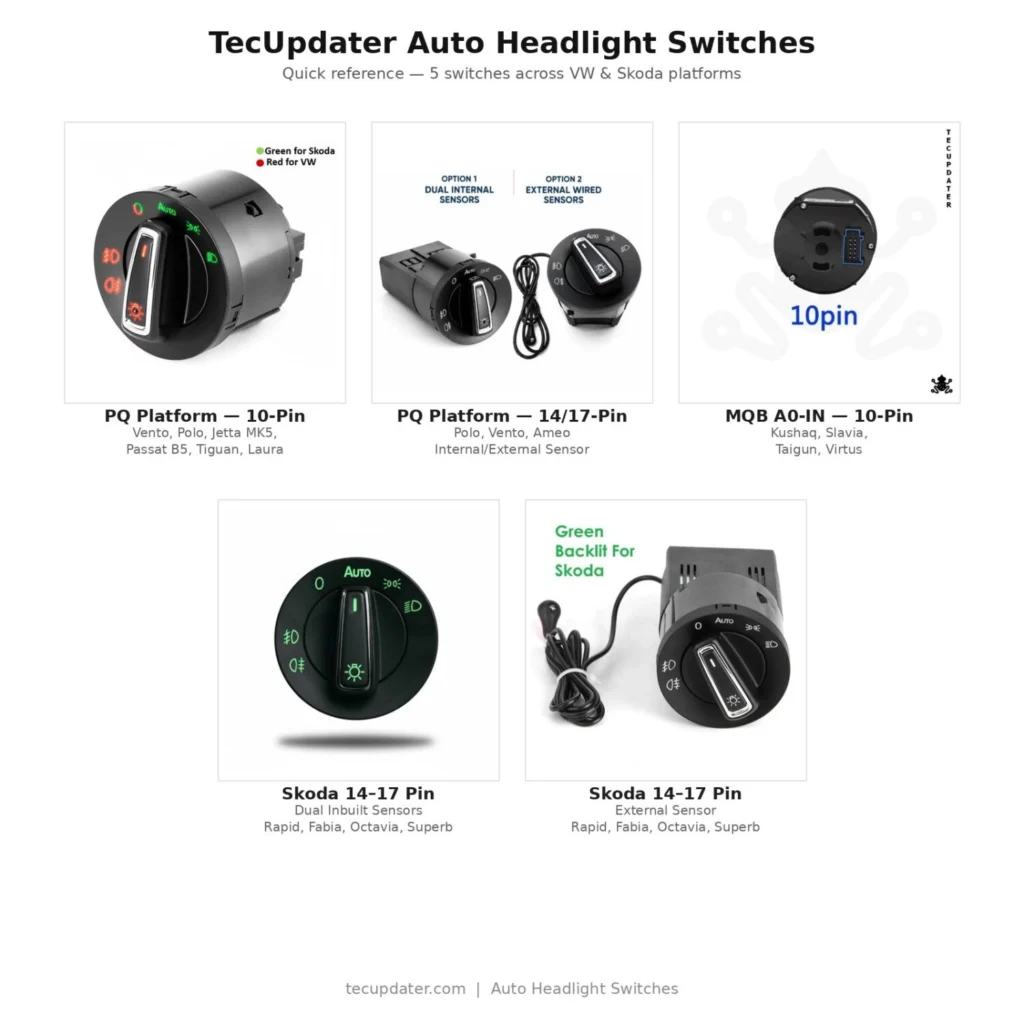
We make and sell auto headlight switches ourselves at TecUpdater, across exactly this VW/Skoda range, so we have a direct stake in how this category gets talked about — which is exactly why we’d rather walk you through what’s actually going on than let a label do the talking. Below, alongside the explanation, you’ll find our own switches grouped by the platform and pin count they actually fit, each backed by a 1-year warranty and an exchange-allowed return policy.
What Valeo actually is — and what it doesn’t make
Valeo is a real company, not a name someone invented to sound premium. It’s one of the world’s larger automotive suppliers, and lighting and visibility electronics (wipers, switches, lighting systems) is one of its four core business divisions. Valeo has manufactured in China since 1994 as part of its global footprint, and it does supply genuine switches to automakers, and sell parts under its own name through its own official aftermarket channel — a real, Valeo-branded multi-function switch for select Volkswagen models, for example, is listed and sold directly under Valeo’s own name.
Here’s the part that actually matters for this category, though: on the genuine factory auto-headlight system, the switch itself doesn’t contain a light sensor. The light-sensing hardware is a separate component — a Rain/Light Sensor (RLS) module mounted on the inside of the windshield, usually right behind the rearview mirror, wired independently into the car’s body control module. It reads ambient light (and, on the combined version, rain) and feeds that into the car’s own electronics; the switch just has to be turned to the “AUTO” position and let the car’s existing sensor do the work. A Valeo or any other Tier-1 supplier’s OE-spec switch is built to that assumption — it’s designed to work with a sensor that’s already elsewhere in the car, not to carry one itself.
Why cars without factory auto-headlights need a different kind of switch
That single design fact explains the whole product category you’re actually shopping in. A car that never had auto-headlights from the factory also never got the RLS module or its wiring loom fitted at the factory. Bolt on a genuine-spec switch with an “AUTO” position and nothing happens — there’s no sensor anywhere in the car to tell it when it’s dark. Getting the real factory function retrofitted the OEM way means sourcing the actual RLS module, running its wiring, and coding the car to recognise it — which is exactly what you’ll find described in the DIY retrofit and coding threads VW, Skoda and Audi owners have written for this over the years, and it’s a bigger, pricier job than swapping a switch.
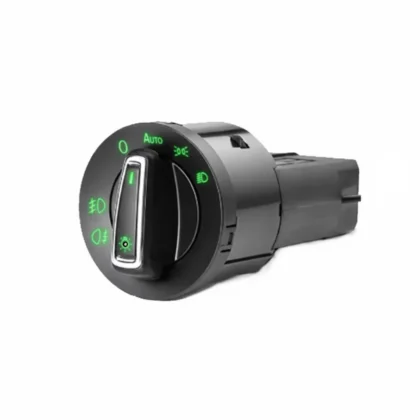
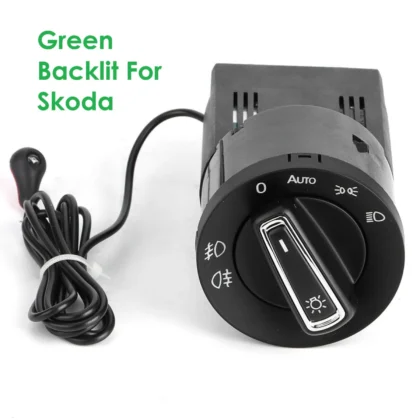
What’s sold as an “auto headlight switch” for a Polo, Vento, Kushaq or Slavia in this market solves the same problem a different way: the sensor is built into the product itself, either inside the switch housing (an “internal sensor” variant) or as a separate small sensor on its own wire that mounts on the dashboard (an “external sensor” variant, useful on cars with tinted windows) — both packaged as part of the one unit you buy, and both designed specifically so no BCM coding is needed. That’s a genuinely different piece of engineering from a factory RLS retrofit, built to solve a problem — no sensor infrastructure in the car at all — that a real OE-spec Valeo switch was never designed to solve on its own.
Put simply: if a switch has a built-in or external-wire sensor bundled with it, that alone tells you it isn’t an OE-spec Valeo (or other Tier-1) part, regardless of what name or country appears on the packaging — because a genuine OE switch was never designed to carry a sensor in the first place. These self-contained sensor-and-switch units are a separate category of product, engineered by other manufacturers (several traceably based in China) specifically to add the auto-on/off function to cars the factory sensor system was never fitted to.
Why a brand name or a country sticker isn’t a reliable quality signal here
The useful version of “don’t trust the label” isn’t “everything not labeled X is fake.” It’s this: any switch in this category that includes a built-in or external-wire light sensor is, by design, not an OE-spec Valeo or Tier-1 part — genuine factory switches never carry a sensor, because that’s the separate RLS module’s job. Once you know that, the brand name on the box stops being the useful question. The useful questions are how well that bundled sensor is calibrated, how exactly the connector matches your car’s harness, and whether the seller will stand behind it if it fails — none of which any label on the packaging actually tells you.
Counterfeit and mislabelled parts are a well-documented, ongoing problem across India’s auto-parts aftermarket generally, not unique to this switch category — packaging, country stickers, and brand names on small accessory parts are comparatively easy to replicate and are not independently audited before a listing goes live on most marketplaces. That’s exactly why the label shouldn’t be doing the work of telling you whether a specific switch is good — the switch itself, and the seller behind it, should be.
What actually determines whether a switch is any good
| What to check | Why it matters more than the brand name |
|---|---|
| Sensor type — internal (cabin-mounted) vs external (windshield-mounted) | Internal sensors are simpler to fit but read light through the windshield, which tinted glass can throw off; an external sensor avoids that but needs a visible mounting point and an extra wire run. |
| Exact pin count and connector shape (10-pin, 14-pin, 17-pin) | This is what actually determines whether it plugs into your car’s harness at all — a switch with the “right” part number but the wrong pin count for your exact model year simply won’t seat properly, brand name or not. |
| Coming Home / Leaving Home support on your specific car | Some cars’ BCM (body control module) logic doesn’t support this function regardless of which switch is fitted — a seller who tells you this upfront, rather than promising it works everywhere, is a better signal than any label. |
| Sensor calibration and response time | This is the actual functional difference between a good and a poor unit in this category, and it has nothing to do with what’s printed on the housing — it comes down to the specific manufacturer’s build quality. |
| Seller’s warranty and return/replacement policy | Since no brand name here carries an independently-backed manufacturer’s warranty the way a genuine OEM dealer part would, the seller’s own stated terms are what you’re actually relying on if the switch is faulty. TecUpdater backs every switch in this guide with a 1-year warranty and an exchange-allowed return policy, stated upfront on each listing — use that as the baseline to compare against whichever seller you’re considering. |
A practical checklist before you buy
Ask the seller to confirm the exact pin count and connector type for your specific model and year — not just the general part number. Ask whether it’s an internal or external sensor, and if external, whether the mounting hardware and extra wire are included. Ask directly whether Coming Home/Leaving Home will work on your car — a seller who says “it depends on your BCM, let me check your variant” is being straight with you; one who promises it unconditionally on every model may not be. And weigh the seller’s own warranty and return policy more heavily than any brand or country claim on the packaging, since that’s what you’ll actually be relying on if something’s wrong. On TecUpdater’s own switches, that answer is simple: 1-year warranty, exchange allowed — worth using as a baseline whichever seller you end up buying from.
Why buy your auto headlight switch from TecUpdater
Getting the platform and pin count wrong is the single easiest way to end up with a switch that doesn’t fit — which is exactly why we list our own auto headlight switches by the exact vehicle group and connector they’re built for, rather than one generic listing for the whole VW/Skoda range. The three groups below each fit a specific pin count and platform, every one of them backed by a 1-year warranty and an exchange-allowed return policy, so if you’ve confirmed the fit against your own car and it still doesn’t work out, you’re covered.
Auto Headlight Switches for Volkswagen & Skoda — PQ Platform (Polo, Vento, Ameo, Jetta, Passat, Tiguan, Laura, Octavia)
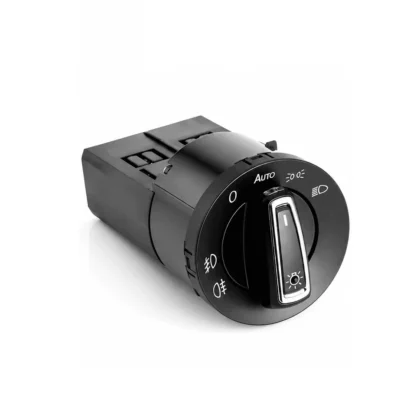
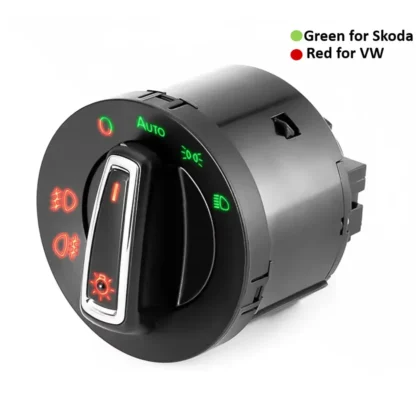
Pin count on this platform isn’t one-size-fits-all — it genuinely depends on your exact model, generation and trim, which is exactly the kind of detail this guide keeps pointing back to. The 5ND941431A-family switch is a 10-pin connector, fitting Vento (2019-onwards Highline Plus), Polo, Jetta MK5, Passat B5, Tiguan, Skoda Laura and Octavia; the second switch below is a 14-pin/17-pin connector for Polo, Vento (excluding the last DRL-equipped Highline Plus variants) and Ameo, with a choice of internal or external sensor. Confirm your exact pin count and model year with the seller before ordering either — don’t assume one pin count carries across the whole platform.
Automatic Headlight Switch for VW Polo, Vento & Ameo – 14 Pin & 17 Pin, Internal or External Sensor
Price range: ₹5,459 through ₹5,644 Select options This product has multiple variants. The options may be chosen on the product pageAutomatic Headlight Switch 5ND941431A for VW Vento (2017 Onwards, Highline Plus, DRL), Jetta, Passat, Tiguan & Skoda Laura
Price range: ₹4,800 through ₹5,768 Select options This product has multiple variants. The options may be chosen on the product page
Auto Headlight Switch for Skoda Kushaq, Slavia & VW Taigun, Virtus (MQB A0-IN Platform)
These India-spec MQB A0-IN cars use a 10-pin 5GG941431D / 5GM941431A connector — not the 14/17-pin connector used on the older PQ-platform cars above or the export-market Skoda models below, so don’t carry a pin count over between platforms just because a part number looks similar.
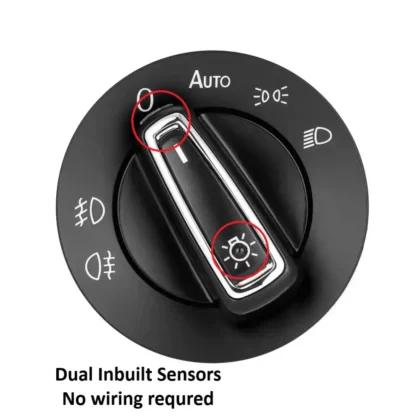
Auto Headlight Switches for Skoda Rapid, Fabia, Octavia & Superb (14–17 Pin)
These fit the 14-pin/17-pin connector used on this Skoda range, with a choice of dual inbuilt sensors or an external windshield-mounted sensor (the better option on tinted-window cars). On 2018-onwards examples of these models, a BCM limitation means Coming Home/Leaving Home and automatic fog-light activation aren’t supported regardless of which switch is fitted — check your specific model year before assuming otherwise.
FAQs
Is this switch genuine Valeo?
No, and by design it can’t be. This switch has a built-in (or external-wire) light sensor bundled into it, and a genuine OE-spec Valeo switch never carries a sensor — on the factory system, light-sensing is done by a separate Rain/Light Sensor module elsewhere in the car, not inside the switch. We sell these as TecUpdater-branded aftermarket switches built specifically to add auto-headlight function to cars that never had that factory sensor hardware fitted at all — not as a genuine Valeo or any other Tier-1 supplier’s part, and we don’t claim any affiliation with Valeo or an automaker’s original supply chain.Does the country-of-origin sticker on a listing actually tell me anything?
Not reliably, for this product category. Country and brand claims on small retrofit accessory parts aren’t independently audited by most marketplaces before a listing goes live, so a sticker alone isn’t proof of where a specific unit was actually made. Judging the seller’s transparency and support matters more than the sticker.What’s the real difference between an internal and an external sensor switch?
An internal sensor sits inside the cabin, usually near the dashboard, and reads ambient light through the windshield — simple to fit, but tinted glass can affect its accuracy. An external sensor mounts outside, typically near the windshield base, reading light directly — more accurate on tinted cars, but needs a visible mounting point and an extra wire run to the switch.Will Coming Home / Leaving Home work with any of these switches?
It depends on your car’s BCM logic, not just the switch. Some newer Skoda models built from around 2018 onward have a BCM limitation that blocks this function regardless of which switch is fitted — check the specific listing’s compatibility notes for your model and year before assuming it’s supported.Do I need BCM coding or a VCDS/OBDeleven tool to install one of these?
No — these are designed as plug-and-play replacements for the existing switch slot, using the car’s existing wiring and connector. No coding tool is required for the switch itself to function.Why do prices vary so much between sellers for what looks like the same switch?
Because this category is supplied by multiple manufacturers at different quality tiers, and the same OEM-compatible part number gets sold by many unrelated sellers, each sourcing their own stock. Price differences usually reflect real differences in the underlying unit’s build quality and the seller’s own margin and support, not a genuine-vs-fake split.Will fog lights also turn on automatically with these switches?
On some cars, yes, as part of the automatic lighting logic; on certain models — including some 2018-onward Skoda variants — automatic fog light activation isn’t supported due to the same BCM limitation that affects Coming Home/Leaving Home. Check your specific model’s compatibility notes.Is professional fitting required?
Not necessarily for the internal-sensor variants, which usually swap directly into the existing switch slot. External-sensor variants need a wire routed to a mounting point outside the cabin, which is a bit more involved — a car electrician can usually fit either in well under an hour.What warranty applies to these switches?
TecUpdater backs its auto headlight switches with a 1-year warranty and an exchange-allowed return policy, stated on each product listing. Since no independent manufacturer warranty applies to this category the way it would on a genuine dealer-supplied OEM part, whichever seller you buy from, get their warranty and return terms confirmed upfront — that’s the real protection here, not any brand name on the box.
Sources referenced in researching this guide: Valeo (Wikipedia) and Valeo’s own aftermarket division, for general background on what Valeo actually manufactures and sells under its own name; and a Rain/Light Sensor module explainer, for how the factory light-sensing hardware is a separate windshield-mounted component from the switch itself.